Frozen Storage in Dammam: A 2026 Cold-Chain Guide for Exporters
For any business shipping perishables through the Eastern Province, reliable Frozen Storage in Dammam is no longer a luxury — it is the backbone of a profitable cold chain. Dammam sits beside King Abdulaziz Port, the Kingdom’s busiest Gulf gateway, which makes it the natural staging point for seafood, meat, dairy, and frozen ready-meals moving in and out of Saudi Arabia. In 2026, as food imports and re-exports keep climbing, getting your freezing strategy right is what separates a healthy margin from spoiled inventory.
This guide breaks down how modern frozen warehousing works in Dammam, what temperatures different products demand, and the questions you should ask before signing a storage contract.
Why Dammam is the Kingdom’s cold-chain hub
Dammam’s position is simple geography turned into commercial advantage. Goods arriving by sea can move to a temperature-controlled facility within minutes, cutting the exposure window that destroys frozen product quality. The city also feeds the industrial corridor linking Dammam, Dhahran, and Al Khobar, where food processors and HORECA suppliers cluster.
Three factors make the Eastern Province especially demanding:
- Summer ambient temperatures routinely exceed 45°C, so even a short loading-dock delay risks partial thaw.
- High humidity accelerates ice-crystal formation and freezer burn on exposed product.
- Port throughput means facilities must handle sudden volume spikes without warming up.
Choosing Frozen Storage in Dammam that is engineered for these conditions protects both food safety and shelf life.
Temperature zones: matching the product to the setpoint
Not every frozen item belongs at the same temperature. A well-run facility segments its chambers so that sensitive goods are never compromised by a shared setpoint. The table below shows the ranges that cold-chain operators in the Gulf typically maintain.
| Product category | Recommended temperature | Typical storage window |
|---|---|---|
| Ice cream & frozen desserts | -25°C to -22°C | 6–12 months |
| Seafood & shrimp | -25°C to -18°C | 6–9 months |
| Red meat & poultry | -20°C to -18°C | 8–12 months |
| Frozen vegetables | -18°C | 10–18 months |
| Frozen bakery & dough | -18°C to -15°C | 3–6 months |
The Saudi Food and Drug Authority publishes binding requirements for how frozen food must be handled across the Kingdom, and compliance is checked at import. You can review the official framework through the Saudi Food and Drug Authority, which sets the baseline every warehouse must meet.
What does quality frozen warehousing actually include?
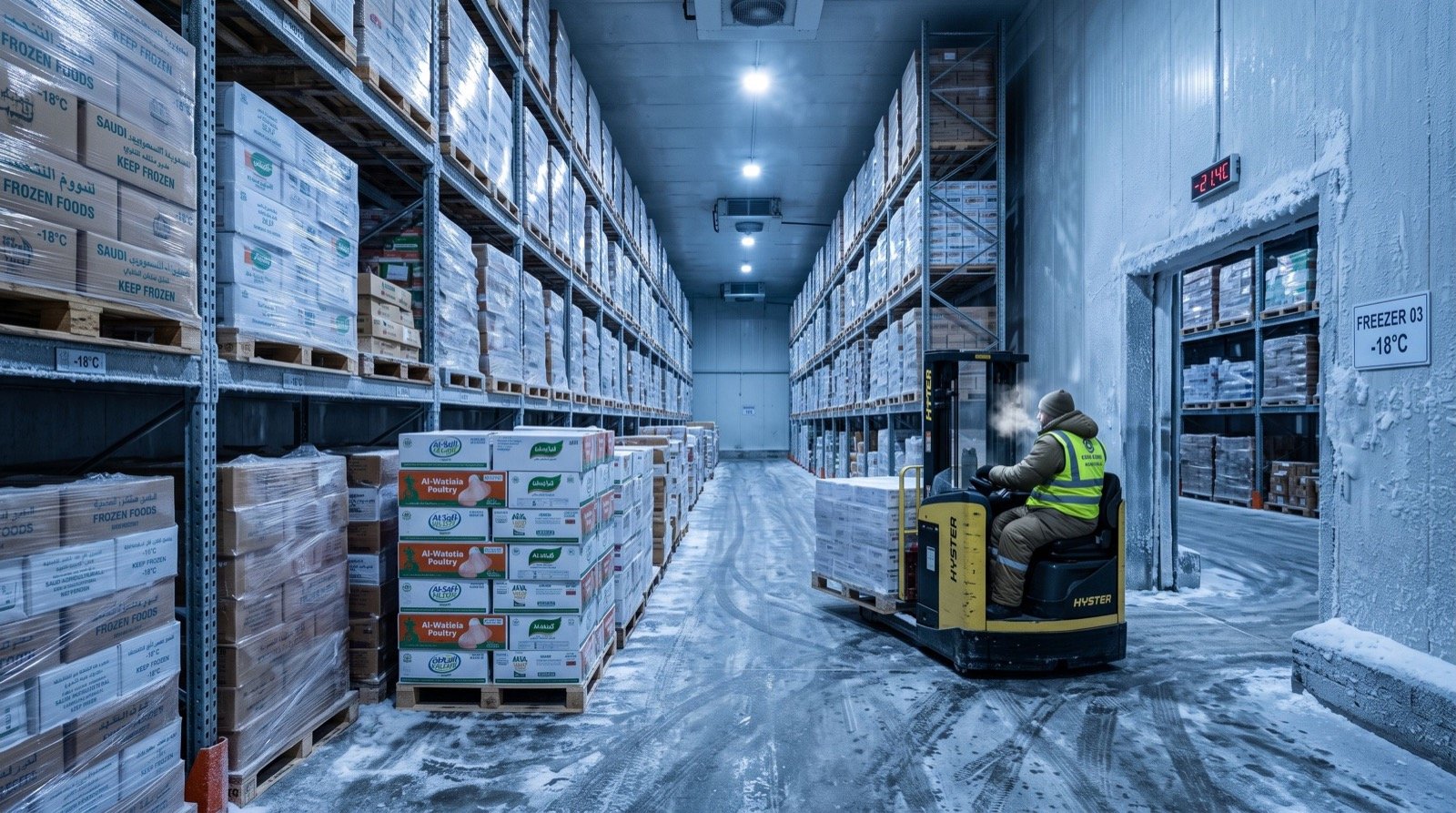
A freezer is only as good as the systems around it. When operators evaluate a provider of professional Frozen Storage in Dammam, they look well beyond the headline temperature. The real differentiators are the monitoring, redundancy, and workflow discipline that keep product frozen solid from dock to dispatch.
Core features of a credible facility include:
- Continuous temperature logging with automated alerts if any chamber drifts outside its band.
- Backup power — generators that cut in within seconds of a grid failure, because a freezer with no power is a countdown clock.
- Blast-freezing capacity for product that arrives fresh and needs rapid core freezing to lock in cell structure.
- Separate chilled and frozen chambers so chilled goods never force a freezer to work above its design range.
- Insulated loading docks and dock shelters that seal the trailer to the building during transfer.
The international cold-chain standard for food safety is well documented by the Food and Agriculture Organization of the United Nations, whose guidance on maintaining an unbroken cold chain underpins best practice across the region.
Beyond food: frozen logistics for other sectors
Dammam’s cold storage demand is not limited to food exporters. Pharmaceutical distributors, industrial sample labs, and even specialty retail all tap into temperature-controlled warehousing. The same discipline that protects a pallet of frozen shrimp also protects temperature-sensitive consumer goods.
Consider the parallels with fashion logistics. Just as a freezer protects food from heat damage, climate-controlled warehousing protects garments and textiles from humidity, mould, and fibre degradation. Specialist providers now offer dedicated Storage for the Fashion Industry, applying the same environmental-control principles to apparel that cold-chain operators apply to frozen food. The lesson is universal: controlled environments preserve value.
How to choose the right partner in 2026
The market has matured, and so have customer expectations. Businesses increasingly want flexible, pay-for-what-you-use contracts rather than locking into a full warehouse lease. When you compare options, prioritise providers who publish their uptime record and let you audit their monitoring data.
A practical, first-hand tip from operators who manage seasonal seafood volume: always confirm the facility’s pull-down time — how fast a chamber returns to setpoint after a door opening or a power event. Facilities that cannot answer this quickly are usually the ones that run warm during peak load. Working with established, quality service providers who document their performance gives you leverage and peace of mind.
Use this quick checklist before committing:
- Does the contract guarantee a temperature band, not just “frozen”?
- Is 24/7 monitoring included, and can you receive the alerts too?
- How is inventory tracked — manual sheets or a real-time WMS?
- What is the recovery plan if a compressor fails during a Dammam summer?
Frequently Asked Questions
What temperature defines true frozen storage?
True frozen storage holds product at -18°C or colder, the internationally recognised threshold that halts microbial growth. Sensitive items like ice cream and seafood often require -22°C or lower to preserve texture and prevent freezer burn.
How much does Frozen Storage in Dammam cost?
Pricing depends on pallet volume, required temperature, and contract length. Most 2026 facilities quote per pallet per month, with lower rates for longer commitments and shared-space arrangements that avoid the cost of a dedicated room.
Can one facility handle both chilled and frozen goods?
Yes. Well-designed warehouses operate separate chilled (0–4°C) and frozen (-18°C and below) chambers so each product sits at its correct temperature. Ask whether the zones are physically isolated to avoid cross-conditioning.
What happens to my stock during a power outage?
Reputable operators run automatic backup generators and well-insulated chambers that hold temperature for hours. Confirm the generator transfer time and ask for the facility’s documented outage-response procedure before you sign.
Conclusion
Dammam’s role as the Kingdom’s Gulf gateway makes dependable cold storage a competitive necessity in 2026. By matching each product to the right temperature, insisting on real monitoring and backup power, and partnering with operators who prove their performance, you protect both your inventory and your reputation. Whether you move seafood, dairy, or frozen ready-meals, investing in professional Frozen Storage in Dammam is the surest way to keep your cold chain unbroken from port to plate. Review your current provider against the checklist above, and upgrade before the next summer peak tests your margins.